
Beca AES 2024: Work-Life Reconciliation Policies and Family Health: Fertility, Maternal, and Children’s Health


In recent decades, many countries have adopted policies to facilitate conciliature between working and family life. Among them include the low parthes, which allow the parents of the, in some cases with remuneration and protected fee, take care of their newborn. At the end of the 90s, alber of 60% of the industrialized countries of the newly low maternity, but the exclusive casualties for parents were uncommon. Nordic countries were pioneers in their implementation in the 80 12.7 weeks Of low paternity.
Today, the extension of these casualties and their comparison between the two parents is promoted to advance gender equality both in the labor market and at home. Without obstacle, its effects can go further, influencing the composition and decision -making of the home, as well as aspects of child care, fertility and health. The 2024 Health and Health Economics Research Scholarship granted by the Associative of Health Economics in collaboration with Novartis, financed a project whose objective was to study these dynamics.
Context
This project takes advantage of the staggered implementation of paternity decline in Spain to study its effects on health. In April 2007, an exclusive paternity decline was introduced for parents of children born from March 24 of that year. This consisted of 14 days completed, in a mode of «Use -it O-Perder-IT»: If the father did not use it, the home lost the right. For accessories, parents had to be employed or actively looking for employment and comply with a minimum price. The decline should be taken during the two weeks in Medediatamatere to after the strike, coincided -with the first weeks of the maternity leave, which since 1989 was 16 weeks (six obductories after delivery, and the remaining ten with the baby’s possibility of life).
The loss of fatherhood was extended in successive reforms. In 2017 it extended to four weeks, continuously simultaneously with the mother; In 2018 a fifth week was added; In 2019, the duration increased to eight weeks with two mandatory after childbirth and the remaining six available before the first year. In 2020, the permit was extended to 12 weeks, with four mandatory in mediatame after delivery. Finally, in 2021, the permits of both parents were matched at 16 weeks, with six mandatory after the birth and the rest available during the first year. Figure 1 curriculum is evolution.
Figure 1. Change in paternity and maternity permits in Spain over time, expressed in weeks. The discontinuous line represents the rights of maternity leave, and the continuous line, those of low paternity. Source: Own elaboration.
It should be noted that, while the introduction of two weeks in 2007 was not announces in advance, the subsequent extensions were, which could have given Lugo to strategic behaviors in births. However, the analyzes performed do not find evidence in this regard.
¿Do parents accept down?
Before there were exclusive permissions for the father, only 2% of the parents made use of the transferable weeks, total seasonal, that the mother could give in to him. After the introduction of two exclusive weeks in 2007, the rate of use increased to 40 %. With the extension to a month in 2017, more than 60 % of the parents accepted down. Finally, in 2021, with 16 weeks for progenitor body, 80 % of parents use permission, matching the rate of use of mothers, which remained stable throughout Perioyo (Graph 2).
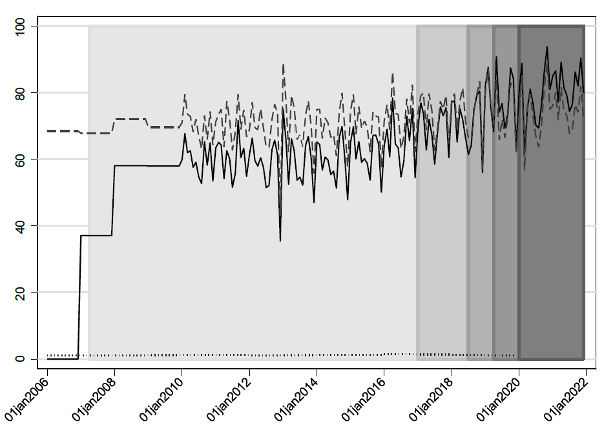 Figure 2. Benefits by monetary permission as a proportion of births. The line continues representation The loss of paternity permits, the dotted line indicates the benefits for parents who claim periosidos compared to the low of maternity, and the discontinuous leader reflects the leave of low matnity. Shadowed areas indicate the reforms. Annual child data before 2010 and monthly a starting. Source: Own elaboration with data from the National Institute of Statistics and Social Security Statistics.
Sufficient son two, four or twelve weeks?
Paternity casualties can act as a sign of a state that drives an «active paternity», promoting new dental dynamics of the home. This can transform social norms, the family organization and the Taran distribution. Therefore, it is that its impact on the Spanish case, the evidence points to lasting consequences: a more equitable distribution of domestic tasks, adolescents More egalitarian gender standards AND Less stereotyped professional decisions Among those who grew up in homes where the father was able to accept down.
What do we see in births?
In Spain, previous studies have already shown that the introduction of paternity decline affected fertility: Beniciad families tend to Delay the following birthwhich translates into a fall in fertility between mothers of mayor, with a more pronounced impact on couples with Intermediate income differences Among them. However, given that paternity policy can induce social and behavioral changes, their effects on fertility could take manifest. Therefore, beyond the effects on those who had a child around the introduction of the casualty (media effects), We analyze how births evolve among all couples who had a child after the implementation of each reform and how effects change over time.
Using synthetic control techniques for temporary series and birth records of the Nacional Statistics Institute, we build contributions of fertility, measure as the number of births per 1000 women, in the absence of these policy. Together, we do not observe an aggregate effect on the birth rate per thousand women from 16 to 44 years. On the other hand, we do find fertility increases between occupied and non -first -time mothers, specially after the initial implementation of the policy, with effects that persist up to two years Ases. These results are aligned with previous literature that does not find aggregate effects (as on studies of Cools et al EITHER Duvander et al), But heterogeneous effects, such as increases in Third births.
The identification of groups of groups of groups suggests that birth support policies could be more effective if they go to those who face greater costs, for example, in relation to labor conciliation. In turn, the absence of effects on first -time mothers could point to the need for componing these measures considered child care, other financial incentives or improvements in labor flexibility. These resulting findings in Spain, where the fertility rate is below the European average and the general replacement level.
How does it affect children’s health?
Exte ample evidence on the Influence of the environment during childhood in child welfare and its resulting throughout life. While great part of this literature focuses on the mother’s role, the father’s investment in terms of time has received less attention. This study, we also analyze the effect of paternity decline, such as proxy of the presence and time of the father, in child health.
To do this, we use primary atnnon records and apply a discontinuity focus on deceased, which allows to isolate the effect of politics against other stationary factors that affect childhood health, such as Composition of births per monthhe school calendar WAVE flu season.
The results show a reduction of 8% in medical diagnoses, and 9% in the case of infections, special respiratory (graph 3). This effect is concentrated in the first year of life, in homes with rent below the median and after reforms that extended the decline to a month and three months. A possible mechanism behind this reduces is the maintenance of formal care (as a guarruter) by a mayor of parental care, which reduces the exposure a environments where infections are They propagate easily.
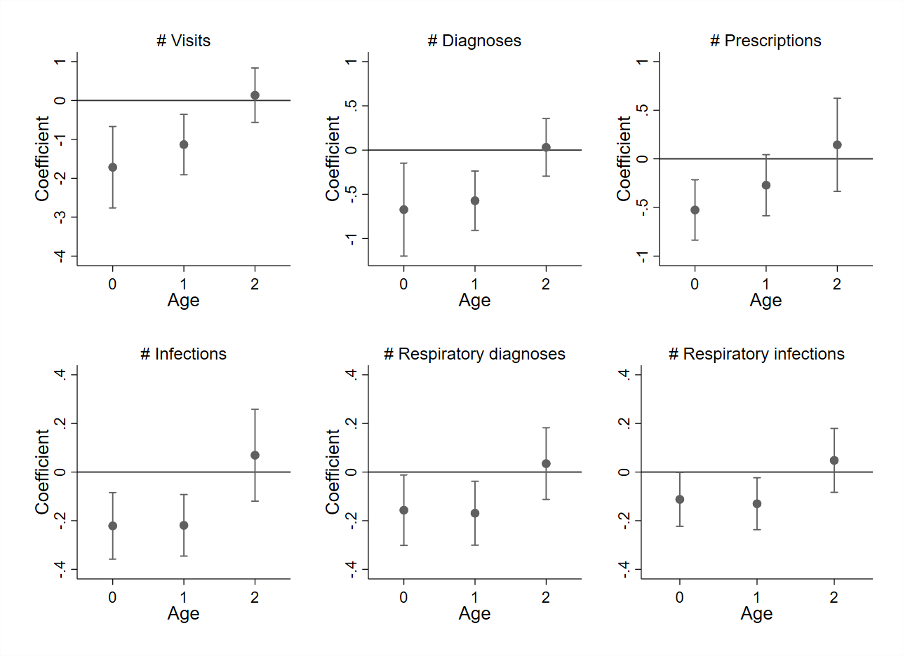 Figure 3. Effect of the implementation of the 12 -week paternity permit. Each indicator corresponds to the number of visits, prescriptions or diagnosis accumulated until the different ages. Data source: Primary Care Clinical Database (BDCAP) 2011-2022.
These falls in the diagnoses, specially in the early years, highlight that the polyics that promote the implication of the father can have more durable effects than the life’s own duration. Specifically, they affect the environment in which children grow, with possible implications on their future health and their development of human capital.
What about mothers?
We are. The objective is to evaluate whether the presence of the father after birth, favored by decline, influences maternal health. This effect could produce through a more balanced cast in home tasks, care and work between parents, or for accompanying and changes in the cost of opportunity to seek medical assistance. To do this, we follow the mothers during the first nine months after childbirth and analyze their visits to primary care, diagnoses received, derivations a specialist and prescription of medication. The results are still in process.
Finally, note that the end of the AES scholarship has been fundamental to carry out this research.


